Starter
Up to 500 analysed hours / month€1,190 / month
Best for: one floor, a single scorecard to begin with.
- Unlimited users and roles
- Unlimited scorecards and campaigns
- The learning loop and the red-flags inbox
- Dial hygiene and CRM lookup
An AI quality analyst that listens to every recorded client call, scores it against your own scorecard, flags what must never be said, tracks what matters and coaches the agent — and learns from your managers' decisions.
Built and run in production by Growth Engine on its own sales floor first — now offered to other companies.

In our own operation — the first five days in production, 7–12 October 2026. Not a customer claim.
Quality management is still a person with headphones and a spreadsheet. Everything outside that sample is invisible — until it becomes a complaint, a chargeback or a regulator's letter.
The sample is tiny and rarely random. Whatever happens on the other 98% never reaches a review, a score or a coaching session.
An income promise or pressure after a "no" is found by the regulator or through a chargeback — long after the call, and with the evidence against you.
Feedback is built on the few calls a team leader happened to hear, and busy-looking agents — click "call", hang up — keep their place on the dashboard.
Wherever a recorded conversation carries commercial and regulatory weight.
Multiple teams, campaigns and clients on one floor, each with its own scorecard and script.
Regulated fintech sales floors: no income promises, no pressure after a "no", no advice on the customer's debts.
Sentiment, objections and resolution tracked on every contact, not on a weekly sample.
Script adherence, discovery, objection handling and tone — measured call by call, agent by agent.
Pulled automatically from the phone system every hour. Only real client calls of 60 seconds or more are taken — you decide the sources, directions, minimum and maximum length, daily caps per team or per agent, and the numbers never to analyse.
Zoom Phone · Squaretalk · any PBX via API or SFTPWhisper large-v3 with speaker separation — agent, customer and system announcements kept apart. English today, validated in production; the model supports 90+ languages. Runs on a dedicated GPU server; the audio never leaves the machine.
~40 s to transcribe a 10-minute callAn open-weight LLM reads the transcript against your scorecard — criteria scored 0–5 or yes/no, weighted to a total out of 100 — and writes the summary in the shape you asked for, the outcome, sentiment, objections and how they were handled, a coaching tip, red flags with the exact quote, the events you count, script-step adherence and the talk metrics.
~2 min to score · currently Gemma 4 26BThe calls list with filters; the call page with player, clickable transcript and the scorecard with evidence quotes; the agent dashboard with trends against the previous period; the red-flags inbox with a bell to the right roles; and a library of best and bad calls for training.
Runs 24/7 · ~450 calls a day on one mid-range GPUPlayer with an agent-and-customer timeline, six talk metrics, the full transcript, the summary, red flags with the reviewer's decision, the events counted, and the scorecard with the quote that earned each mark. Click a quote and the audio jumps there.

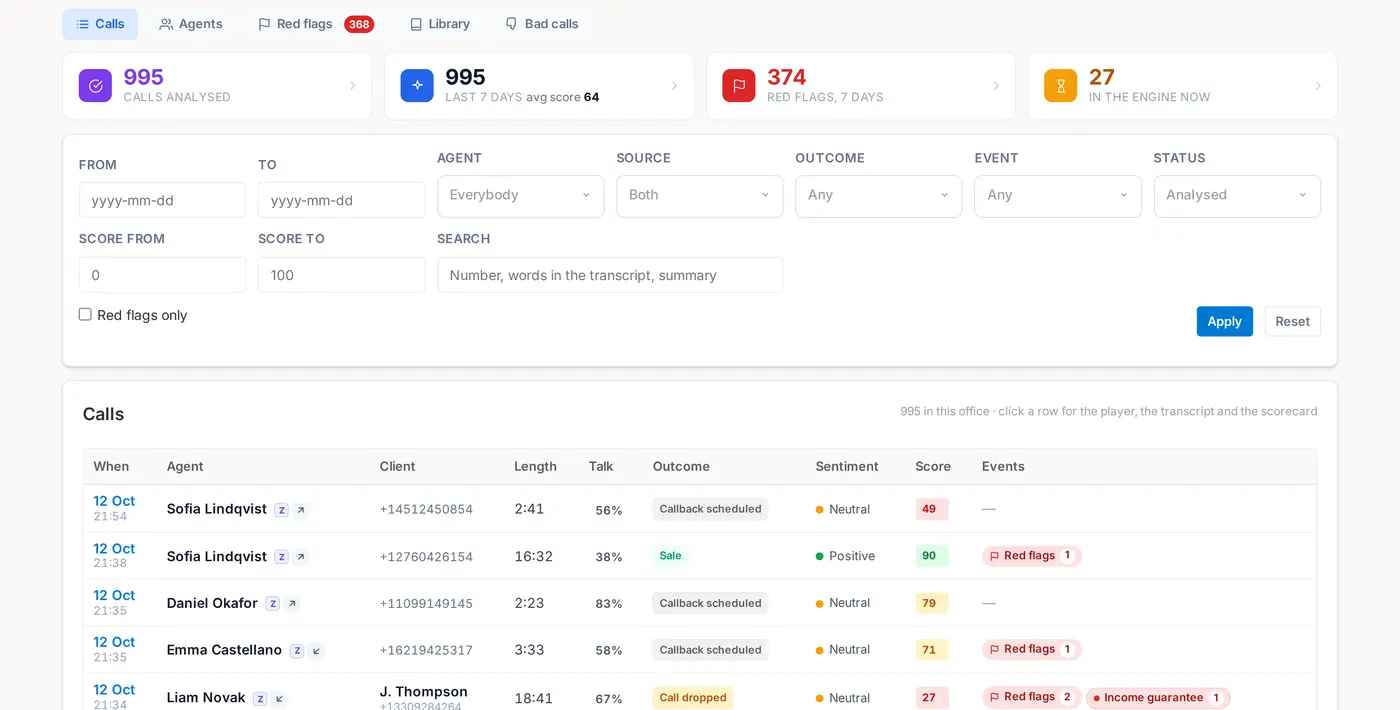
Filters by date, agent, source, outcome, event, status and score range, plus free-text search across the transcript and the summary. Each row carries talk share, outcome, sentiment, score and the events that fired.
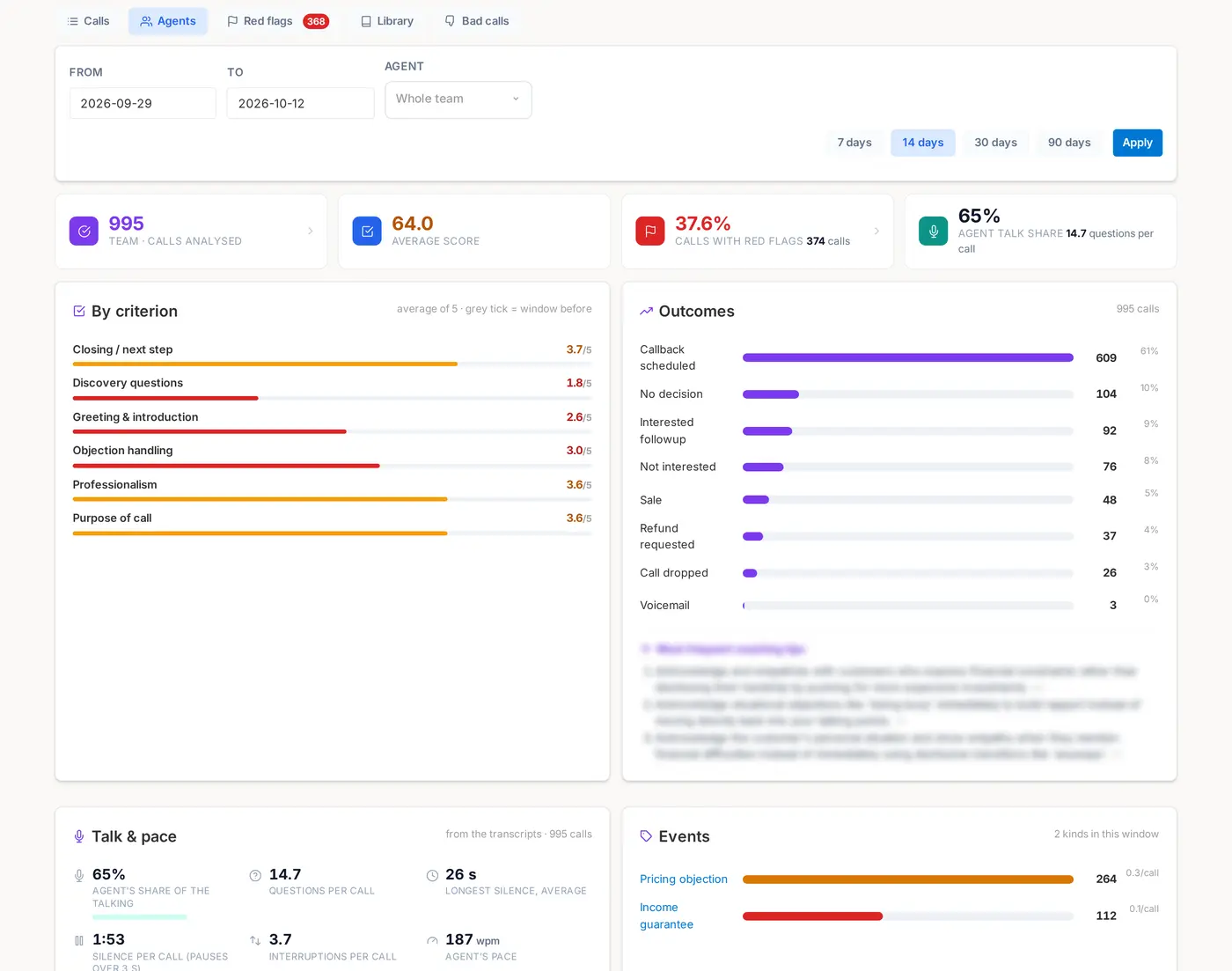
Scores per criterion against the previous period, the spread of outcomes, talk and pace, and the events over the last fourteen days — with the best and weakest calls one click away.
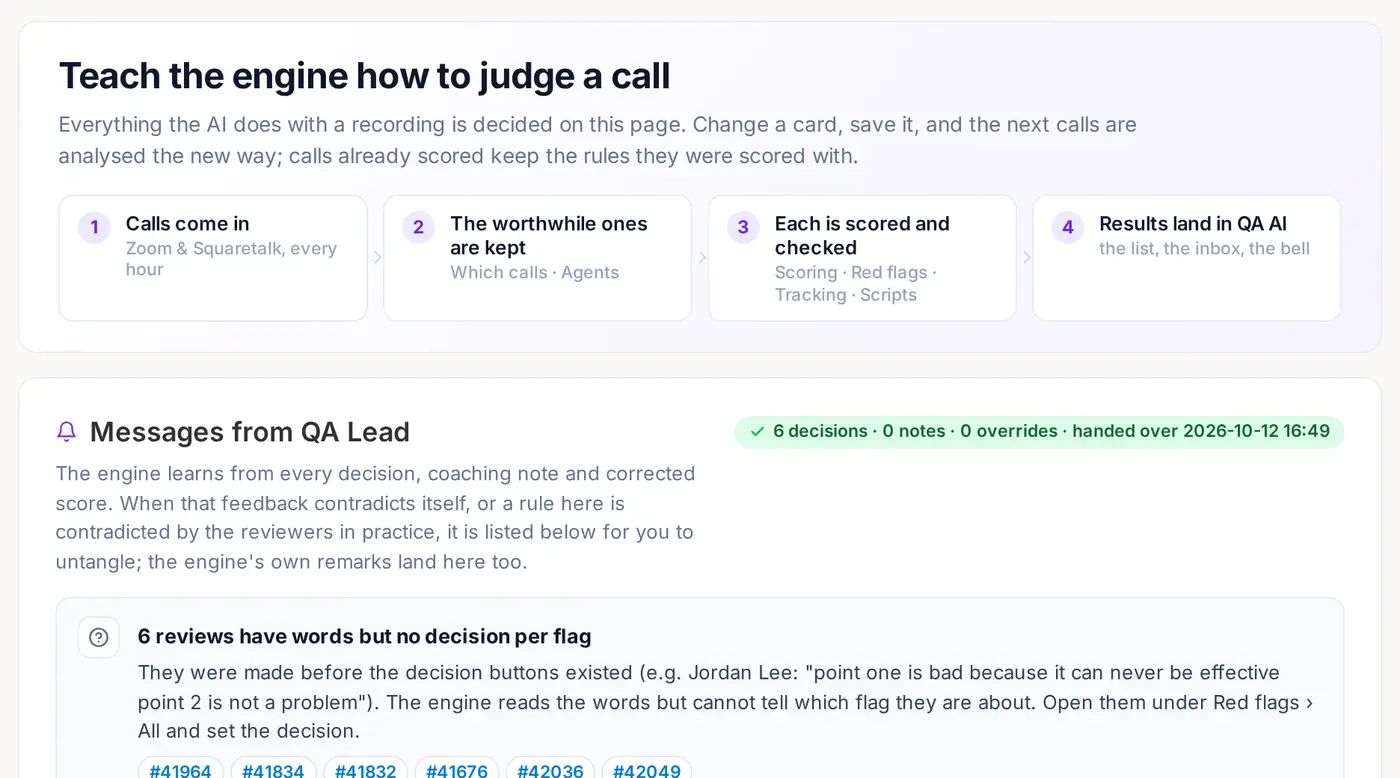
Scoring criteria and their importance, red flags written in plain words, what to track, the script and its steps per campaign, the shape of the summary, which calls are worth analysing, which agents, and a plain-language brief about the business — all from one setup page.
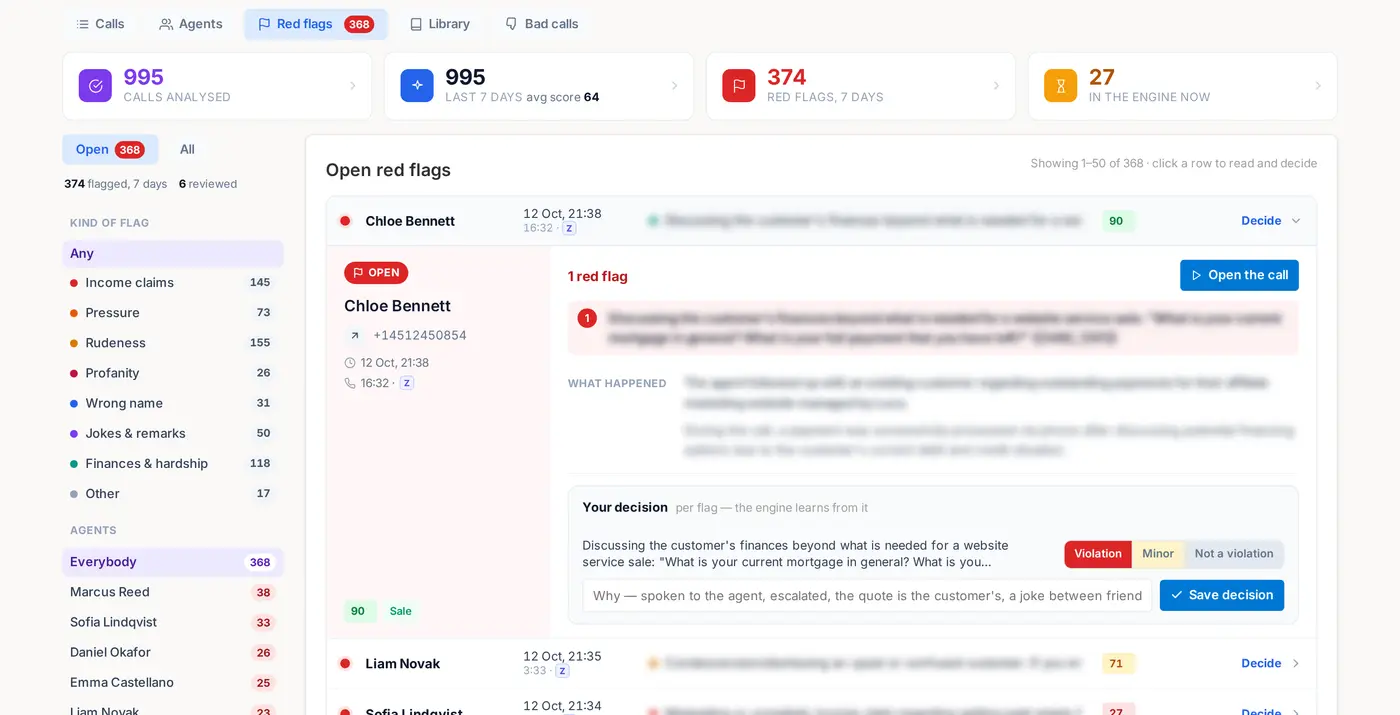
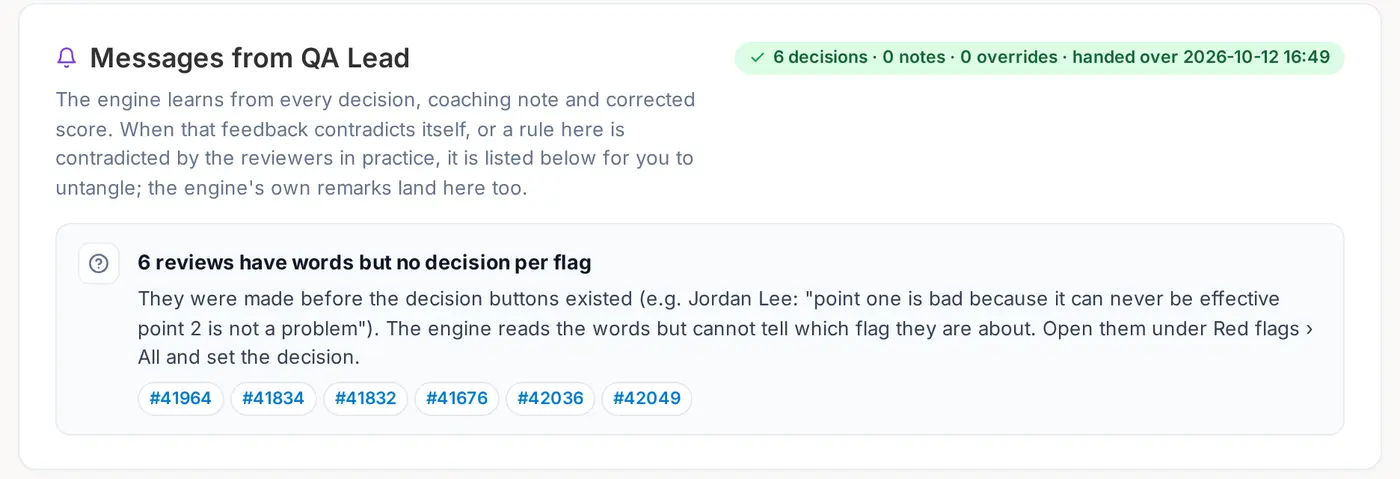
Every red flag gets a decision, per flag — Violation, Minor or Not a violation — in the reviewer's own words. Every coaching note and every corrected score is handed back to the engine and used as calibration on the next analysis.
"The agent promises or implies guaranteed income." That is the whole rule — no keyword lists, no regular expressions. The engine reads meaning, flags the call and quotes the sentence that broke it.
AI QA is a monitoring tool. It does not carry, and does not claim, any regulatory certification.
“The agent promises or implies guaranteed income.” A rule, exactly as it is typed into the setup page.
Built in, out of the boxEach rule fires on meaning, not on keywords, and arrives in the inbox with the sentence that broke it, the surrounding context and a decision waiting from your reviewer.
of calls carried at least one red flag — things managers had never heard
average score across 995 calls
weakest criterion, "discovery questions" — next week's coaching
Most common flags: misleading income claims, pressure tactics, rudeness, discussing the customer's finances.
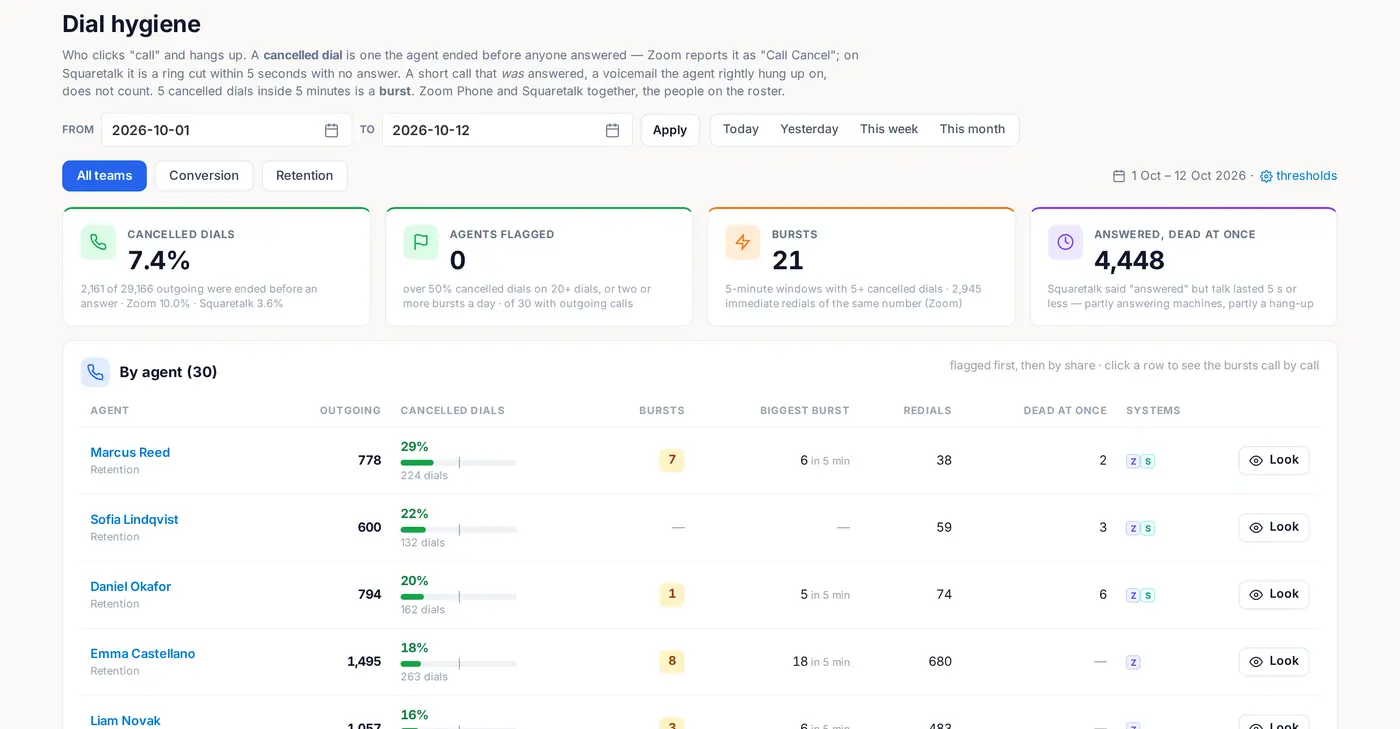
A separate report that catches the dials ended before anyone answered — cancelled dials, bursts of them in minutes, immediate redials of the same number — across both phone systems, on one roster. A short call that was answered, a voicemail the agent rightly hung up on, does not count.
One dedicated GPU server does the work. Recordings, transcripts and scores never go to a third-party AI API.
Zoom Phone and Squaretalk are connected today. Any PBX that exposes its recordings over an API or SFTP can be added.
The number is looked up in your CRM or ERP: name, country, campaign, status, deposits and the client's other calls.
Whisper large-v3 for transcription and an open-weight LLM for scoring, both on your dedicated machine. No third-party AI API sees a second of audio.
Ours runs an NVIDIA RTX 4000 Ada (20 GB) with 64 GB of RAM and handles about 450 calls a day, 24/7.
Historical recordings can be analysed too — point the engine at the archive and it works through it.
The market charges roughly $1.20–$3.00 per analysed hour, billed in tokens, with overage on top once the monthly allowance runs out. We price by analysed hours, in flat plans, and tell you the number before you sign.
€1,190 / month
Best for: one floor, a single scorecard to begin with.
€3,490 / month
Best for: several teams, campaigns and scorecards side by side.
€9,290 / month
Best for: large or regulated operations with their own requirements.
Above 10,000 hours a month: a quote, sized by the number of dedicated servers. Every plan includes unlimited users, unlimited scorecards and campaigns, the learning loop, dial hygiene and CRM lookup. A one-off setup fee of $1,000 covers the dedicated GPU server and the phone-system integration. No overage, ever: when a plan's hours are used up, the engine stops until the next month — move up a plan and it starts again straight away.
Move the numbers to your reality. The result is the volume we would be analysing each month, the plan it falls into, and what the same volume costs at market rates.
Only real client calls of 60 seconds or more are analysed, so the true figure is usually lower than the raw dial count.
1,575 hours
15,750 calls
English, today — it is what runs in production on our own floor. The transcription model supports 90+ languages; if your floor works in another one, we test it on your own calls before you commit.
One to two weeks, including the phone-system integration, your scorecard, your red-flag rules and the first calibration round with your reviewers.
Yes. Point the engine at the archive and it works through it, so you have a baseline before anyone changes how they sell.
Your managers do. Every red flag is reviewed and decided per flag — Violation, Minor or Not a violation — and every decision, coaching note and corrected score is fed back as calibration. The review assistant flags where your own reviewers contradict each other, so the standard converges instead of drifting.
It lands in the red-flags inbox and a bell goes to the roles you choose. A reviewer opens the case, reads the quote in context, plays that moment of the call, and records a decision in their own words. The decision stays with the call as an audit trail.
Access is role-based — you decide whether agents see their own scores and coaching tips, whether team leaders see their team, and who reaches the red-flags inbox.
No. AI QA analyses recorded calls after they end. There is no real-time, in-call coaching.
Nowhere. Transcription and scoring run on your dedicated GPU server with open-weight models. No recording, transcript or score is sent to a third-party AI API.
Tell us what you run and we will show you the product on a call like yours — scored, flagged and explained. We reply within 1–2 business days.